Localize Your Website into Greek
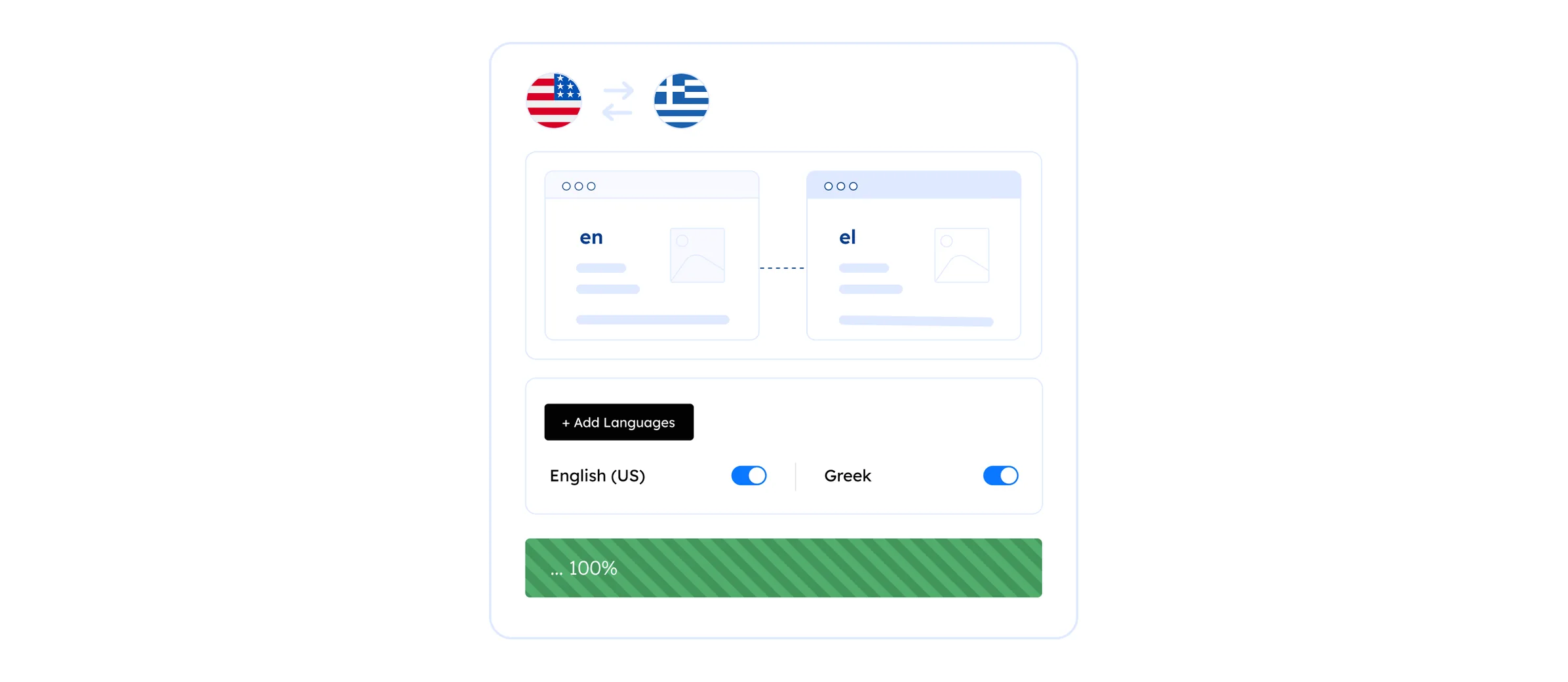
Reach 13.5 million Greek speakers across Greece and Cyprus, plus a well-resourced diaspora of several million more in the US, Australia, and Germany. Greek has its own alphabet, its own EU membership, and a locally distinct spoken dialect in Cyprus that formal written content generally doesn't need to chase. MotaWord translates directly into Standard Modern Greek with linguists who know where Cyprus and Greece actually differ.



Greek at a Glance
- 13.5m speakers worldwide.
- 2 countries, Official status.
- EU Official language via Greece and Cyprus.

A loyal, well-resourced diaspora alongside two EU markets
Beyond Greece and Cyprus themselves, the Greek-American community alone numbers around three million people with strong ties to Greek-language brands and media.
$250 Billion GDP
Combined GDP of Greece and Cyprus, two developed EU economies.
3 Million Diaspora
Greek-Americans, the largest and most established diaspora community.
2 EU States
EU member states, Greece and Cyprus, where Greek is an official language.
Growing Finance Sector
Cyprus's finance and tech sectors, alongside Greek tourism and shipping.
Greek-speaking markets
Greece and Cyprus are your two core markets. Note that Cyprus is politically divided, and the Greek-speaking market corresponds to the Republic of Cyprus in the south, not the Turkish-administered north.
Cyprus Co-official ~680K native
Official alongside Turkish in the Republic of Cyprus; everyday spoken Cypriot Greek diverges from the written standard
- Greece: Official, ~10.7M native. Over 97% of the population speaks Greek natively; sets the reference standard for most content
Standard Modern Greek vs. Cypriot Greek
Cyprus operates in a diglossic setup: Standard Modern Greek for formal, written, and official content, and Cypriot Greek, a genuinely distinct spoken dialect, for everyday conversation.
Standard Modern Greek
The correct choice for website content in both Greece and Cyprus. It’s what Cypriots themselves read in media, government, and business content.
Cypriot Greek
A distinct everyday spoken dialect with its own vocabulary and phonology, unintelligible to mainland Greek speakers without exposure. Rarely appears in formal written content.
Cultural and technical considerations
Greek localization mistakes tend to be technical (the alphabet) or political (Cyprus), more than tonal.
-
Greek uses its own alphabet
Not Latin, not Cyrillic. Fonts and rendering need explicit Greek character support, and modern Greek uses simplified monotonic accenting since a 1982 reform, not the older polytonic system. -
Cyprus's political division is a sensitive topic
Keep commercial content neutral and avoid referencing the island's political status beyond what's operationally necessary. -
Diaspora audiences value authenticity over fluency assumptions
Many Greek-Americans and other diaspora members have limited reading fluency but strong cultural attachment. Greek-language content still carries real trust value for this audience. -
Don't write in Cypriot Greek for general content
It's a spoken, not written, register for most contexts. Standard Modern Greek reads as professional and is understood everywhere Greek is spoken.
What Greek localization does for search and reach
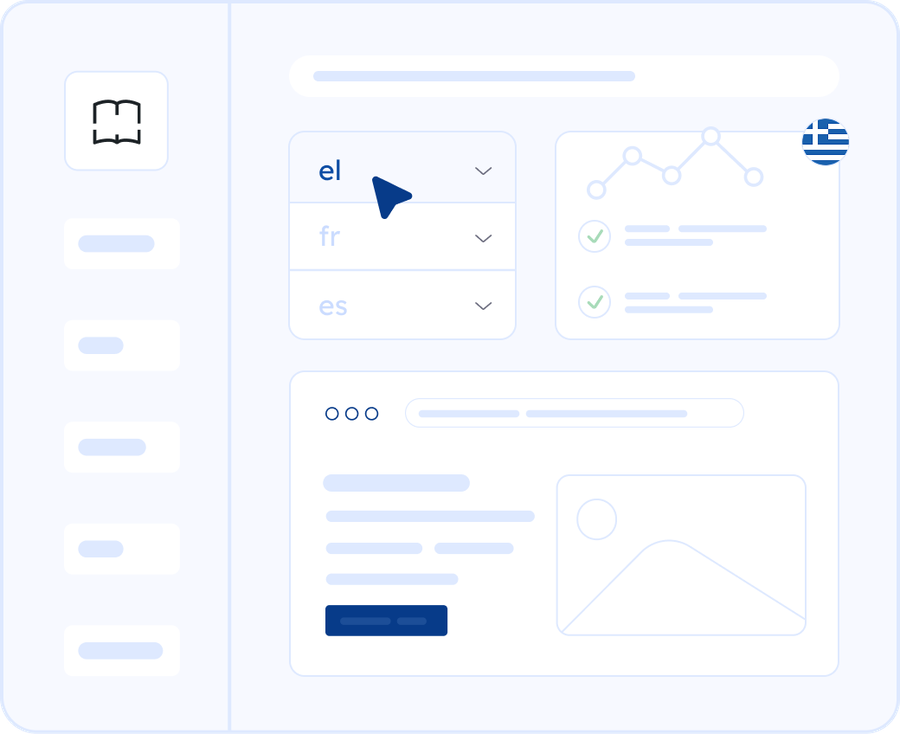
Standard SEO tooling applies, with character encoding being the main technical checkpoint.

Hreflang by market
El-GR and el-CY let you serve and rank Greece and Cyprus content separately if your business needs differ between them.

Character encoding
Greek script needs correct UTF-8 handling in URLs, meta tags, and titles to avoid rendering and indexing issues across browsers.

GDPR and consent expectations
As EU markets, Greek and Cypriot visitors expect standard cookie consent and privacy disclosures consistent with other EU sites.

Google is the standard search engine
No special search engine considerations here; standard technical SEO and Search Console practices apply directly to Greek.
What sets our Greek localization apart

Native Greek linguists
Translators who understand the Greece/Cyprus distinction and default to the correct written standard.

Script-aware DTP
We verify Greek character rendering and modern monotonic accenting before launch, not after.

MotaWord Active
AI makes your website multilingual instantly. Discounted professional translation is available as an optional add-on when you want human review on the pages that matter most.

Fast Professional Proofreading Turnaround
Our collaborative translation model gets full-site projects done in hours, not the weeks a traditional agency needs.

Diaspora-aware guidance
We help you think through tone and content choices for diaspora audiences alongside Greece and Cyprus.

24/7 live support
Direct access to your project team throughout, with no ticket queue.
Need Greek beyond your website?
MotaWord supports Greek beyond website localization, from official document translation to live interpretation.
- Certified Greek translation: Live on site. USCIS-accepted certified translation for birth certificates, diplomas, transcripts, and other official Greek documents. View certified translation →
- On-site Greek interpretation: In-person interpreters for legal proceedings, medical appointments, school meetings, and business events. on-site interpretation services
- Video and phone Greek interpretation: On-demand VRI and OPI interpreters for remote Greek-language support, available 24/7. on-site vs VRI vs OPI interpretation
Translating and localizing a website into Greek
Not sure where to start?
Tell us about your site in the chat. Answer one quick question and we'll point you to the right next step.
Usually not. Standard Modern Greek works for both markets; Cyprus-specific dialect content is rarely appropriate for formal or commercial writing.
Yes, Standard Modern Greek is the right choice there too, since diaspora Greek speakers are generally educated in the standard language rather than a regional variant.
Not automatically. We check font and rendering support for Greek script before your site goes live.
The cost of translating a website with MotaWord depends on the workflow you choose. For file-based website localization, you send us the text, pages, or strings you want translated, and pricing is based mainly on word count and project scope. If you want a more complete website workflow, MotaWord Active runs on a subscription matched to your site. Active makes your website multilingual instantly with AI, includes multilingual SEO support, ongoing content updates, a no-code workflow, and 24/7 live support. If you want human review, discounted professional translation is available as an optional add-on.
With MotaWord Active, your website can be localized into Greek in minutes. Full-site professional translation projects are done in hours, not the weeks a traditional agency needs.
Yes. MotaWord Active makes your website multilingual instantly, and discounted professional translation is available as an optional add-on when you want human review on the pages that matter most.
No. MotaWord Active translates your site without any coding, and we also offer plugins and integrations for platforms such as WordPress and Drupal. See how MotaWord Active works.