Localize Your Website into Traditional Chinese
Reach over 31 million people across Hong Kong, Taiwan, and Macau. Traditional Chinese covers three markets with distinct vocabulary, political contexts, and open access to the global internet, a very different technical environment from mainland China. MotaWord matches native linguists to the specific market you're targeting rather than treating Traditional Chinese as one interchangeable translation.





Traditional Chinese at a Glance
- 31m+ Combined population.
- 3 distinct markets and administrations.
- Open Standard Google and social platform Access.

Three high-value markets with very different economies
Hong Kong and Taiwan are both major, high-income digital economies, and unlike mainland China, standard global platforms and SEO practices work here without modification.
$800 Billion GDP
Combined GDP of Hong Kong and Taiwan, two wealthy markets.
Top 10 Finance Hub
Hong Kong ranks among the world's leading financial centers.
Major Tech Hub
Taiwan's semiconductor and tech industry drives high digital spend.
Open Web Access
Google, Meta, and standard analytics tools all work normally.
Traditional Chinese markets, by reach
Each of these three markets has its own written conventions, spoken language, and administrative status, so treat them as three audiences, not one.
Looking for mainland China instead? This page covers Traditional Chinese for Hong Kong, Taiwan, and Macau. For mainland China and Singapore, see our Simplified Chinese page , which also covers the ICP licensing and Baidu SEO considerations specific to reaching mainland users.
Macau Co-official ~700K population
Chinese and Portuguese are co-official; spoken Cantonese, gaming and tourism-driven economy
Taiwan
De facto national language, ~23M population. Guoyu (Taiwanese Mandarin) has no de jure official status but functions as the national language; Traditional characters throughout
Hong Kong
Co-official, ~7.5M population. Chinese and English are co-official; spoken Cantonese with written Traditional Chinese in a Hong Kong-specific style
Cultural and political considerations
The biggest mistake in Traditional Chinese localization is reusing one translation across all three markets, or assuming it can be adapted from a Simplified Chinese source.
-
Don't reuse one translation across all three markets
Terminology, tone, and even preferred phrasing differ enough between Taiwan and Hong Kong that content built for one often reads oddly in the other. -
Taiwan's political status is a sensitive topic
Commercial content should stay neutral and avoid political framing. Most companies simply list Taiwan as a market without additional commentary, which is the safest default. -
Hong Kong content often keeps English terms intact
Code-switching between Cantonese and English is normal in Hong Kong's commercial and professional register. Full localization of every term isn't always the expected approach. -
Don't adapt from Simplified Chinese
Beyond character conversion, vocabulary and phrasing choices differ. A direct character swap from Simplified content feels mainland-influenced, not native to Taiwan or Hong Kong. -
Macau needs Portuguese consideration too
If you're targeting Macau specifically, especially for government, legal, or gaming-industry content, Portuguese availability alongside Chinese may be expected.
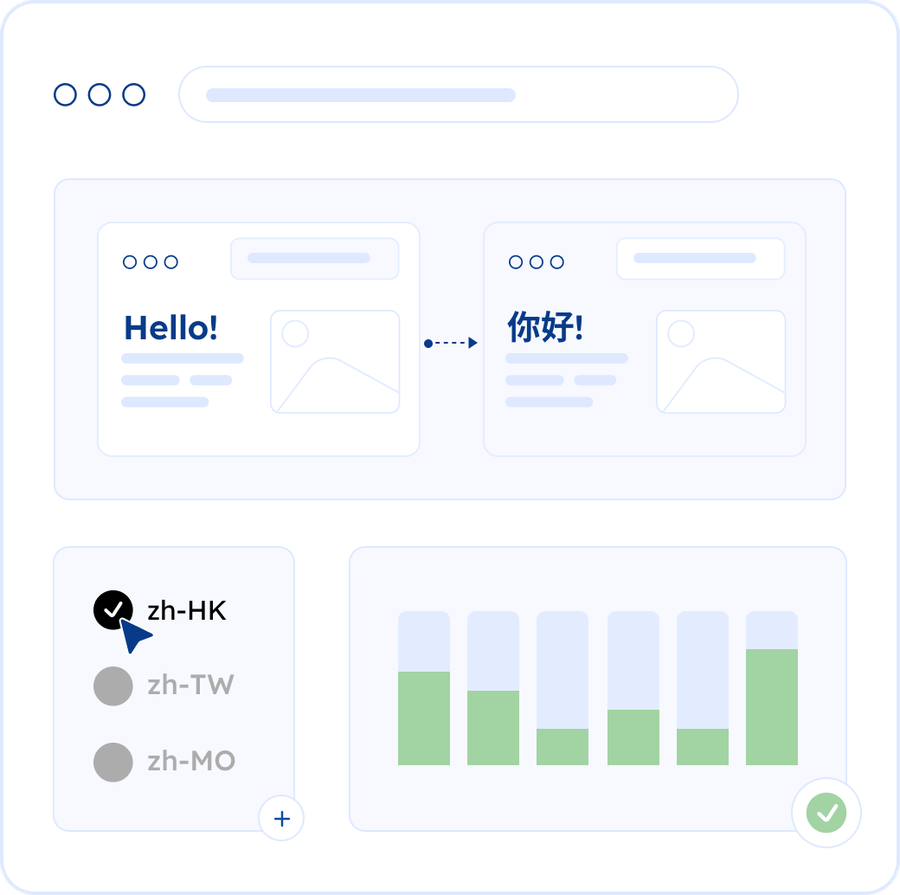
What Traditional Chinese localization does for search and reach
Unlike mainland China, standard global SEO and marketing tools work as expected across all three of these markets.

Standard Google SEO applies
No Baidu-specific optimization or ICP licensing needed. Regular Google Search Console and standard technical SEO practices work normally.

Hreflang by market
Zh-Hant marks the script, with zh-HK, zh-TW, and zh-MO available to target each market's search results specifically.

Meta (Facebook/Instagram) is a major channel
Unlike mainland China, Meta platforms are widely used in both Hong Kong and Taiwan for marketing and discovery.

Local e-commerce platforms matter
Taiwan's PChome and momo, and Hong Kong's HKTVmall, are significant discovery channels alongside your own site.
What sets our Traditional Chinese localization apart
Native linguists by market
Translators matched to Taiwan, Hong Kong, or Macau specifically, not a single generic Traditional Chinese pool.

Direct translation, not conversion
We translate natively into Taiwan Guoyu or Hong Kong-style Chinese rather than converting from Simplified source content.

MotaWord Active
AI makes your website multilingual instantly. Discounted professional translation is available as an optional add-on when you want human review on the pages that matter most.

Fast Professional Proofreading Turnaround
Our collaborative translation model gets full-site projects done in hours, not the weeks a traditional agency needs.

Simplified and Traditional coverage
We handle both scripts, so a single project can cover mainland China alongside Taiwan or Hong Kong if needed.

24/7 live support
Direct access to your project team throughout, with no ticket queue.
Need Chinese beyond your website?
MotaWord supports Chinese beyond website localization, from official document translation to live interpretation.
- Certified Chinese translation: Live on site. USCIS-accepted certified translation for birth certificates, diplomas, transcripts, and other official Chinese documents. View certified translation →
- On-site Chinese interpretation: In-person interpreters for legal proceedings, medical appointments, school meetings, and business events. on-site interpretation services
- Video and phone Chinese interpretation: On-demand VRI and OPI interpreters for remote Chinese-language support, available 24/7. on-site vs VRI vs OPI interpretation
Translating and localizing a website into Traditional Chinese
Not sure where to start?
Tell us about your site in the chat. Answer one quick question and we'll point you to the right next step.
Not for anything beyond very basic content. Vocabulary and tone differences are frequent enough that market-specific versions perform meaningfully better.
Character conversion alone leaves vocabulary and phrasing that reads as mainland-influenced. We recommend translating directly into Taiwan or Hong Kong-specific Traditional Chinese instead.
For general commercial content, no. For government, legal, or gaming-industry content targeting Macau specifically, Portuguese alongside Chinese is often expected.
The cost of translating a website with MotaWord into Traditional Chinese depends on the workflow you choose. For file-based website localization, you send us the text, pages, or strings you want translated, and pricing is based mainly on word count and project scope. If you want a more complete website workflow, MotaWord Active runs on a subscription matched to your site. Active makes your website multilingual instantly with AI, includes multilingual SEO support, ongoing content updates, a no-code workflow, and 24/7 live support. If you want human review, discounted professional translation is available as an optional add-on.
With MotaWord Active, your website can be localized into Traditional Chinese in minutes. Full-site professional translation projects are done in hours, not the weeks a traditional agency needs.
Yes. MotaWord Active makes your website multilingual instantly, and discounted professional translation is available as an optional add-on when you want human review on the pages that matter most.
No. MotaWord Active translates your site without any coding, and we also offer plugins and integrations for platforms such as WordPress and Drupal. See how MotaWord Active works.