Localize Your Website into French
Reach nearly 400 million French speakers across five continents, the world's fourth most spoken language and its fastest-growing major one. Africa is now home to roughly two-thirds of French speakers and nearly all of the language's future growth. MotaWord matches native linguists to France, Canada, and African French specifically, rather than treating French as one uniform market.




French at a Glance
- 396 Million Native Speakers.
- 65% of Speakers Now Live In Africa.
- 22 Countries Official Status.

The fastest-growing major language in the world
French speaker counts have grown from 274 million in 2014 to nearly 400 million today, almost entirely driven by Africa's demographic growth and expanding French-language education.
700M-1B Speakers
Projected French speakers by 2050, mostly in Africa.
4th Most Spoken
Most spoken language in the world, up from 5th in 2022.
2nd Most Taught
Most widely taught language in the world, after English.
$3 Trillion GDP
Combined GDP of France and Canada alone.
French-speaking markets, by reach
French is official in 26 countries and used administratively or educationally in many more. Below are the largest markets by population; official status alone doesn't tell the whole story.
Switzerland Co-official ~2M native
Official in French-speaking cantons, sharing Belgium's distinct numbering conventions
- France: Official, ~65M native. Reference standard for most European French content, subject to the Toubon Law's French-language commercial requirements
- Democratic Republic of Congo: Official, ~77M population. The largest Francophone country by population; French is mostly a second language used administratively and in education
- Algeria: Widely used, not official, ~11.2M speakers. Not an official language, but widely used in business, media, and education
- Canada: Official, ~10M native. Official federally alongside English; sole official language of Quebec, with its own legal requirements for commercial content
- Belgium: Co-official, ~4.5M native. Official in Wallonia and bilingual Brussels, with its own numbering conventions
Which French are you actually writing for?
Vocabulary, numbers, and tone genuinely differ across the major French-speaking regions, enough to affect how natural your content feels to a given audience.
Metropolitan French
The reference standard from France, most commonly used as a default in machine translation and generic localization.
Québécois French
Distinct vocabulary, accent, and cultural identity from France French, with Quebec's own language laws affecting commercial content.
Belgian and Swiss French
Largely close to Metropolitan French, but with different words for 70 and 90 (septante, nonante) instead of France's soixante-dix and quatre-vingt-dix.
African French
The largest and fastest-growing variety cluster, roughly 167 million speakers, with its own vocabulary and expressions that differ meaningfully from European French.
Cultural and legal considerations
French localization mistakes usually come from defaulting to France French for every market, including the ones with their own legal requirements.
- Quebec has its own language law: Quebec's Charter of the French Language requires French-language commercial content in many contexts. This is a compliance question, not just a preference, if you're doing business there.
- France has its own too: The Toubon Law requires French in advertising and commercial communication within France, including translated disclaimers for foreign-language slogans.
- Don't treat Africa as an afterthought: Given where the growth actually is, African French deserves real strategic attention rather than a generic France French translation applied broadly.
- Political status is shifting in parts of West Africa: Mali, Burkina Faso, and Niger have recently downgraded French's official status. Monitor this if you're building a long-term strategy in the region.
What French localization does for search and reach
Standard SEO tooling applies broadly, with hreflang doing a lot of the work to separate genuinely different regional audiences.

Hreflang by region
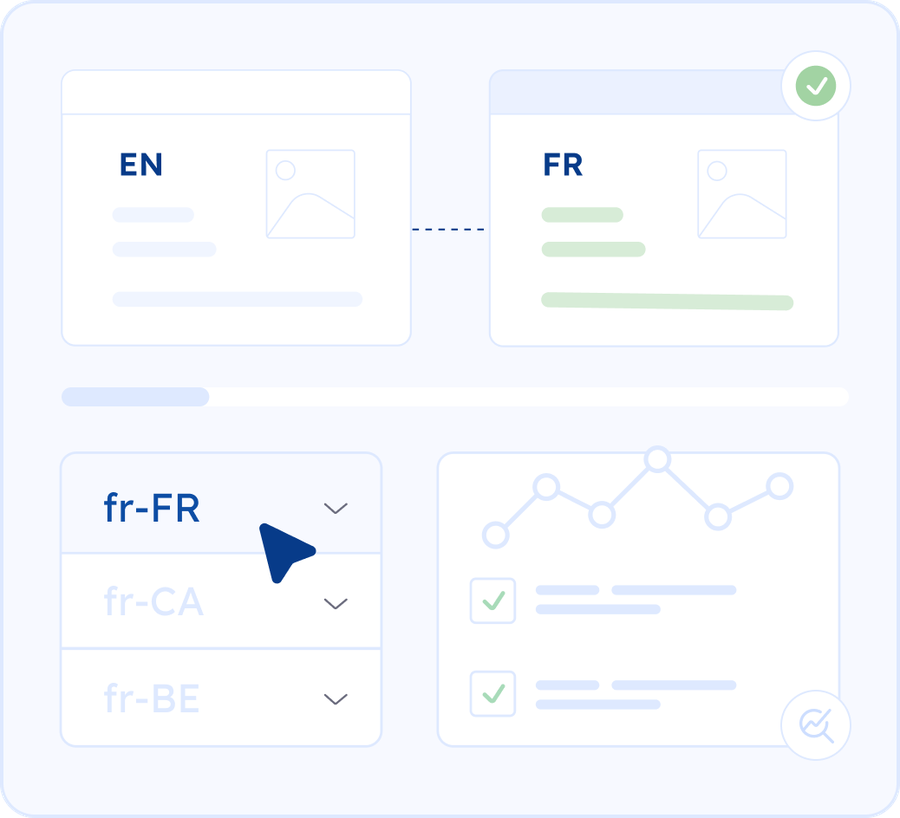
Fr-FR, fr-CA, fr-BE, fr-CH, and country-specific tags for African markets let you serve and rank the right variant for each audience.

Keyword research by market
Search terms genuinely differ between France, Quebec, and African French markets. A single France-based keyword list will miss real search volume elsewhere.

Domain strategy
.fr and .ca ccTLDs are well trusted in their respective markets; African markets more commonly use subdirectories under a global domain.

Google is the standard search engine
No special search engine considerations across the vast majority of French-speaking markets; standard technical SEO applies.
What sets our French localization apart

Native linguists by region
Translators matched to France, Quebec, or African French specifically, not a single generic French pool.
Africa growth-market coverage
Given where French is actually growing, we treat African French as a first-class variant, not an afterthought.

MotaWord Active
AI makes your website multilingual instantly. Discounted professional translation is available as an optional add-on when you want human review on the pages that matter most.

Fast Professional Proofreading Turnaround
Our collaborative translation model gets full-site projects done in hours, not the weeks a traditional agency needs.

Regional compliance awareness
We flag Quebec and France-specific language law considerations early in the project.

24/7 live support
Direct access to your project team throughout, with no ticket queue.
Need French beyond your website?
MotaWord supports French beyond website localization, from official document translation to live interpretation.
- Certified French translation: Live on site. USCIS-accepted certified translation for birth certificates, diplomas, transcripts, and other official French documents. View certified translation →
- On-site French interpretation: In-person interpreters for legal proceedings, medical appointments, school meetings, and business events. on-site interpretation services
- Video and phone French interpretation: On-demand VRI and OPI interpreters for remote French-language support, available 24/7. on-site vs VRI vs OPI interpretation
Translating and localizing a website into French
Not sure where to start?
Tell us about your site in the chat. Answer one quick question and we'll point you to the right next step.
For commercial content targeting Quebec specifically, yes, both for legal compliance with Quebec's language law and because vocabulary and tone genuinely differ from France French.
Not exactly. West and Central African French is the largest sub-variety and a reasonable starting point, but there's meaningful internal variation across the roughly 30 countries involved.
That depends on your specific content and business activity. We can flag what we see, but recommend legal counsel for a definitive compliance read on the Toubon Law or Quebec's Charter of the French Language.
The cost of translating a website with MotaWord depends on the workflow you choose. For file-based website localization, you send us the text, pages, or strings you want translated, and pricing is based mainly on word count and project scope. If you want a more complete website workflow, MotaWord Active runs on a subscription matched to your site. Active makes your website multilingual instantly with AI, includes multilingual SEO support, ongoing content updates, a no-code workflow, and 24/7 live support. If you want human review, discounted professional translation is available as an optional add-on.
With MotaWord Active, your website can be localized into French in minutes. Full-site professional translation projects are done in hours, not the weeks a traditional agency needs.
Yes. MotaWord Active makes your website multilingual instantly, and discounted professional translation is available as an optional add-on when you want human review on the pages that matter most.
No. MotaWord Active translates your site without any coding, and we also offer plugins and integrations for platforms such as WordPress and Drupal. See how MotaWord Active works.